
Leda Irzikeviciene: The main focus is devoted to customers, employees, sustainability, and innovations
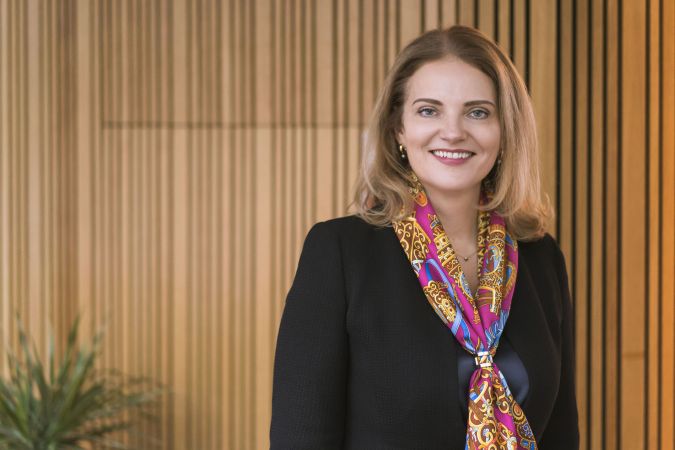
OP Corporate Bank established its branch in Lithuania 10 years ago. During this time, the branch has organically grown to become one of the TOP 5 business financiers in Lithuania, managing a portfolio of EUR 1.2 billion in loans and leasing. Leda Irzikeviciene, the Country Manager of the Lithuanian branch, talks about the bank's activities, part of which is already conducted by robots within the organization, and plans for the next decade.
How have the first few months been for you, after joining the bank at the beginning of this year?
It has been interesting and intense. I have started meetings with clients and had numerous remote calls and meetings with teams from Lithuania, Latvia, Estonia, and Finland, as communication and collaboration are essential when getting to know such a large organization like OP Financial Group.
As soon as I started, I focused on strengthening communication and internal culture. We have initiated various changes aimed at improving our ability to meet customer expectations more effectively and solidify our presence in Lithuania.
What strengths and unique qualities of the Lithuanian branch do you see as one's of the country's largest business financiers?
Over the past ten years, our growth has been entirely organic. We have developed our own client base, focusing on partnering with large and leading medium-sized companies within their respective industries. We have built strong and long-standing competencies within our team, with 11 employees working in the branch since its opening.
Together with the group, we have the capacity to finance large-scale and long-term projects, offering competitive terms due to our group's exceptional ratings among European banks. We are also one of the largest financiers in the transport sector in Lithuania.
What are the bank's goals for the upcoming years in Lithuania?
We have a clearly defined strategy with a priority on our existing customers while also aiming to attract new partnerships with prominent large and medium-sized companies that we have not yet collaborated with. As a universal corporate bank, we offer a full range of banking services, from account management and payment solutions to financing, fund management, guarantees, and deposits.
We have developed sector-specific solid competencies, with experts in renewable energy, real estate, agriculture, transportation, and industrial sectors working in our bank. We continue to strengthen and expand these competencies.
Customer satisfaction is of utmost importance to us. We strive to enhance their experience by focusing on effective communication, efficient and high-quality service delivery, and a deep understanding of their needs. We also aim to ensure the branch's financial stability and risk management and fulfill our obligations to investors. This can only be achieved by consistently responding to our customer's needs, operating efficiently, and fostering a culture of innovation.
With the economy entering a recession, how are the financial needs of companies changing?
We do not see significant changes. We mostly work with companies that have experienced multiple recessions or crises in the past, so they are prepared for the current economic challenges and have sufficient reserves and competencies to survive this economic period. The impact of the recession depends on the sector in which the business operates. Some companies require borrowing during such times, while others perceive opportunities for investments.
Currently, we have not observed a significant decrease in the demand for borrowing among our customers, although everyone is more cautious. However, our customers maintain long-term strategies, viewing this recession as a short-term phase within their broader perspectives. They remain committed to pursuing their long-term goals.
Green financing - how much is the demand for sustainable financing by companies increasing?
We have witnessed a growth in companies' competencies when it comes to sustainable performance. Both consumers and investors are increasingly valuing the responsibility of organizations for the environment and society, and they expect companies to demonstrate sustainable management practices. As a bank, we also impose requirements for companies to meet ESG standards.
The demand for green bonds and sustainable investments has experienced significant growth in recent years. Companies are using green bonds to finance sustainable projects, particularly in areas such as increasing energy efficiency. In the past year alone, our whole bank's sustainable business financing portfolio expanded by 70%, reaching a total of EUR 5.2 billion. Additionally, the bank financed EUR 500 million worth of green bonds through our updated Green Bond Program.
The entire OP Financial Group, part of which we are, not only encourages customers to transition towards sustainable operations but also places great emphasis on sustainability within the organization. Our goal is to operate sustainably in terms of climate and the environment, people and communities, and corporate governance. By 2025, we aim to become a climate-neutral organization. Sustainability is an integral part of our daily routine, and we place great importance on it as we move forward.
What other long-term strategic priorities has the bank planned for Lithuania?
The OP Group places significant emphasis on innovation and technological advancement; it helps us to enhance our services and elevate the customer experience. Technology allows us to compete effectively in the market. We are actively automating processes and integrating intelligent automation into our operations. OP´s automation journey began in 2016 with robots, and we have implemented approximately 400 automation solutions within the group.
Across the Baltic countries, are 6 robots deployed, with 5 explicitly operating in Lithuania. These robots undertake various tasks, such as calculating monthly payments, managing accounting processes, updating customer data, generating audit reports, and preparing lease-ending documents.
To date, these robots have successfully executed more than 10 million operations. Collectively, the robots within our group perform tasks equivalent to what more than 300 employees would typically accomplish in a year. We are proud to have, on average, 100 dedicated employees who are responsible for developing processes as well as implementing and maintaining robots and other automation solutions. Furthermore, we are delighted to have some of them based in Lithuania.
What would you like to see the bank achieving in the next decade?
My vision for OP Bank in Lithuania is to leverage the extensive 120-year experience of the OP Group in Finland and establish ourselves as a robust financial advisor and influential opinion leader within the Lithuanian business community. Together, we can systematically and sustainably build the authority of the financial sector, promote a culture of prosperity, and drive innovation in Lithuania.