
"OP Global Outlook 2025": on the economy, business trends, and geopolitics
Continuing our tradition, we welcomed our customers and partners to the spring business event "OP Global Outlook 2025," held on April 1.
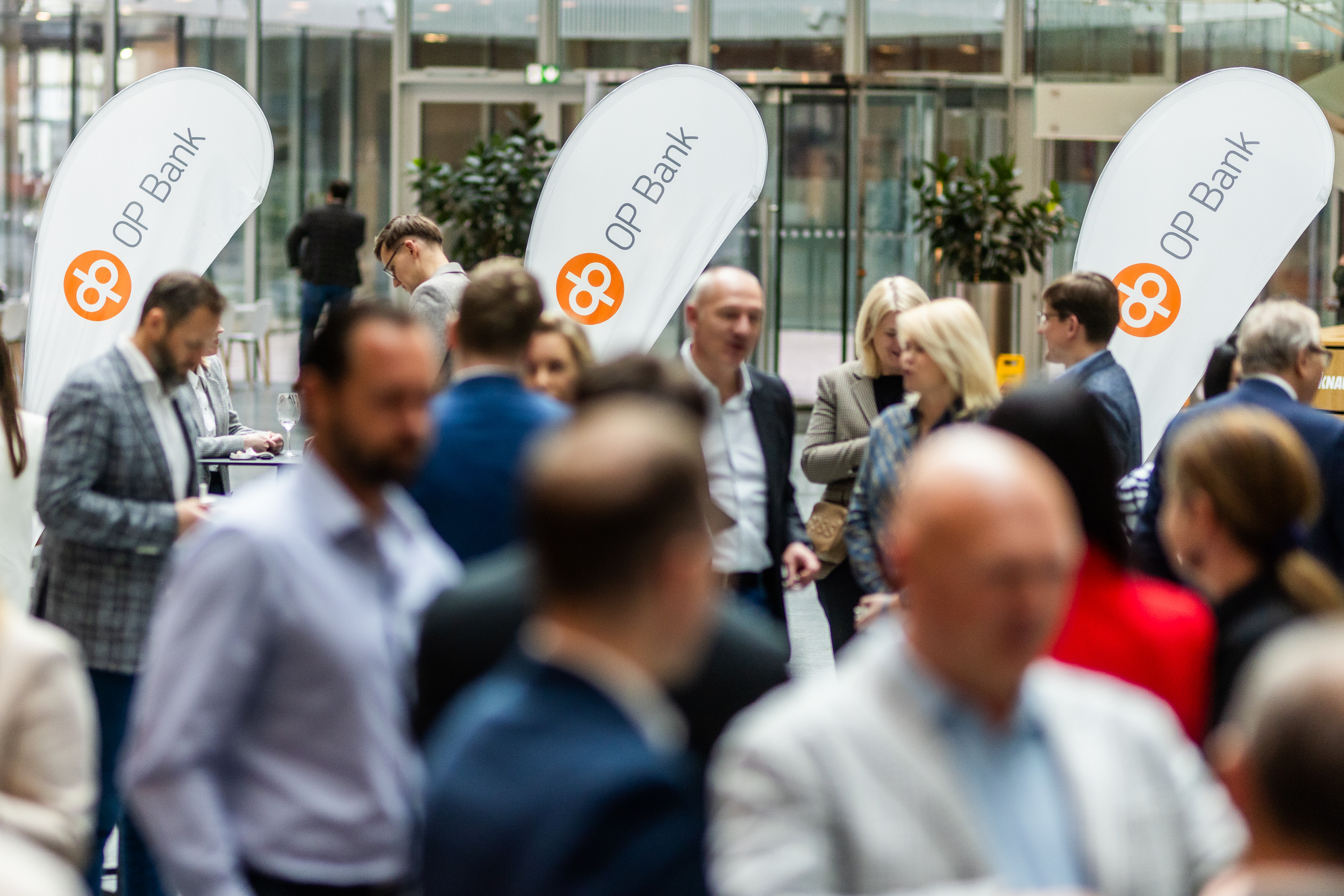
We live in a world where change is happening faster than ever before. That’s why this event served as an excellent opportunity to explore the trajectories of both the global and Lithuanian economies, identify emerging global trends, and discuss new business opportunities.
During the event, "OP Financial Group" Chief Economist Reijo Heiskanen shared insights into the outlook for the global economy. According to him, growth forecasts for both the global and Lithuanian economies remain stable. The industrial sector is recovering, with the European economy expected to grow by 1%, the U.S. by 2%, and Lithuania by approximately 3% this year. However, the index of economic policy uncertainty has already surpassed levels seen during the pandemic—primarily driven by the introduction of new tariffs. A significant theme of the event was the strengthening of European defense. As Heiskanen noted, with consistent investment, Europe could become a notable defense force globally and, in doing so, also strengthen its own economy.
Xiaohan Li, "OP Financial Group" representative specializing in Asian markets, focused on China’s economic slowdown, with GDP growth forecasted at 4.5% this year. Domestic consumption remains weak, unemployment is on the rise, and a demographic crisis is looming due to declining birth rates. Public debt is also increasing. Nonetheless, although the real estate sector has faced significant challenges in recent years, it appears to have bottomed out, with signs of recovery expected in the near future. Europe remains China’s second-largest export market, while China is the EU’s third-largest export destination and its leading import partner.
The event’s discussion segment featured Leda Iržikevičienė in conversation with Linas Kojala, Director of the "Center for Geopolitical and Security Studies", as they examined the geopolitical landscape. Unfortunately, the prospect of sustainable peace in Ukraine remains elusive in the near term. Kojala also highlighted a recent US-Ukraine agreement on mineral resources, suggesting which countries might become key recipients of Ukraine’s reconstruction funds. Speaking on European security, both experts underscored Germany’s pivotal role. While the United States remains the primary security guarantor, Germany will be expected to assume leadership in peacekeeping efforts.
In the panel discussion, Giedrius Dzenkauskas, Head of Corporate Banking at "OP Lithuania", moderated a conversation with Domas Dargis, CEO of "Eika Group", Mažvydas Šileika, Board Member and CFO of "Akola Group", Sabina Chochrina, CEO of "Vlantana" and Sergejus Artemiuk, CEO of "Acme Group".
Business leaders shared ambitious growth plans and an optimistic outlook for the future. The construction sector is seeing a growing number of military-related projects, with large-scale developments underway or planned in Rūdninkai, Klaipėda, and Rukla. Logistics companies are adapting to changes in migration policy and labor shortages by investing in digitalization and sustainable transport solutions. Food production businesses are expanding operations in Lithuania and increasing biofuel production. Meanwhile, the retail sector is actively implementing AI-based solutions—from chatbots to broader product assortments—to meet evolving consumer expectations.