Mikko Hamalainen: systemic risk management allows businesses to focus on core activities
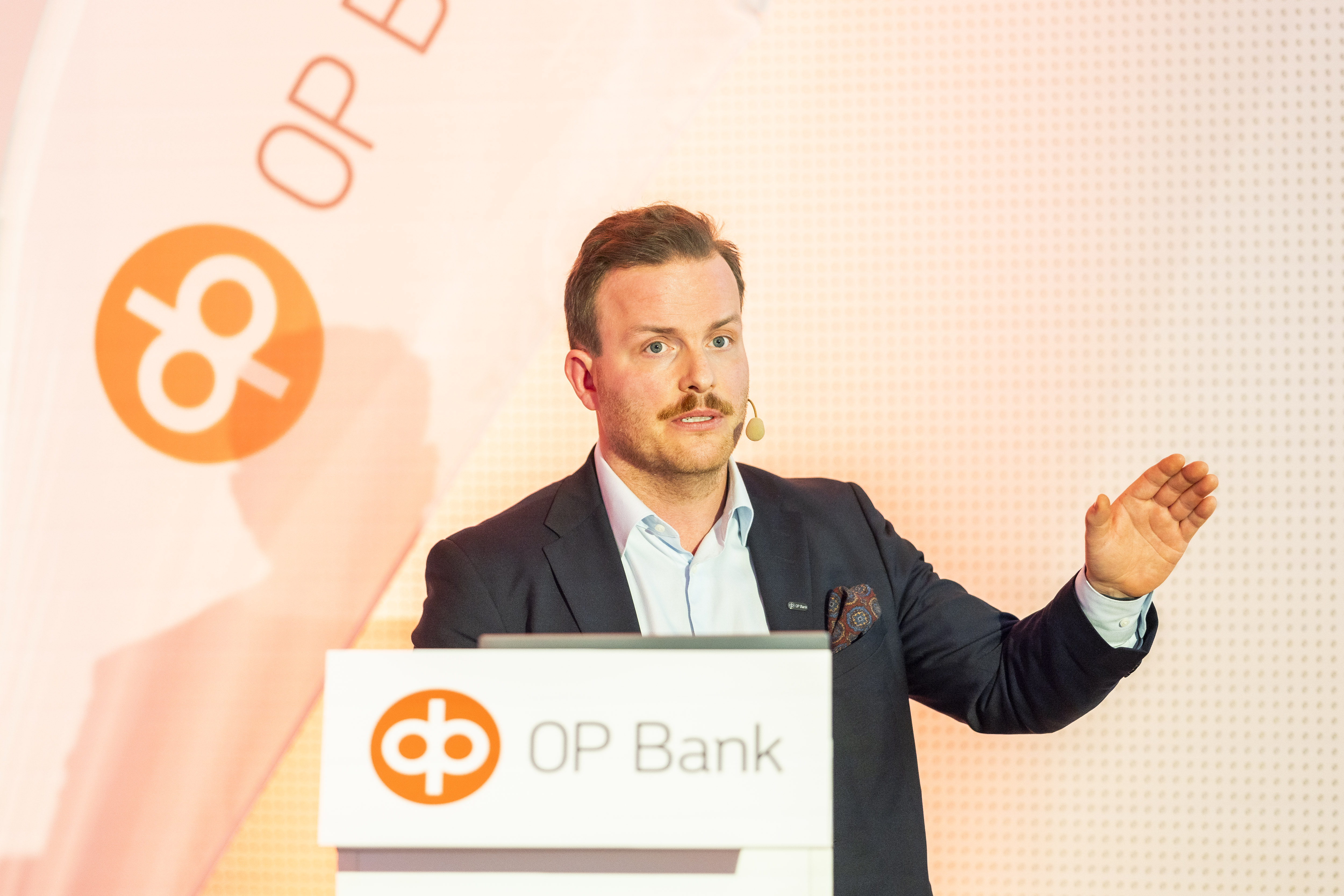
Derivatives can help avoid fluctuations in interest rates, currency exchange rates, commodity prices, and their negative effects on a company's income and cash flows. Mikko Hamalainen, Senior Sales Manager at OP Markets of Finland's financial group OP Financial Group, provides an overview of how often Lithuanian businesses employ such risk management tools and what is worth knowing about them.
For years, you've been advising businesses on risk management issues. When do you notice businesses facing the greatest risks? Are they easy to anticipate?
Businesses typically face the greatest risks when there are significant fluctuations, sudden market shifts, changes in interest rates, or currency exchange rates. For instance, a company might be convinced that it faces no risk due to fluctuations in the Swedish krona or believes it can bear such risk. However, suddenly, with a significant currency exchange rate change, it may become evident that this risk actually had a negative impact on the business, especially if a larger batch of goods was just sold and will be paid for in Swedish krona.
Major unforeseen risks are often revealed by unexpected fluctuations. A perfect example is interest rates, which rose very rapidly a few years ago. At that time, when discussing with our clients, many found it unexpected, especially after a decade of zero or even negative interest rates.
One way of managing business risks is through hedging instruments. Which companies is this most relevant for?
Every company should carefully assess the risks that may affect their profitability or cash flows. And it's important to do it systematically – only then can appropriate risk management measures be chosen. Assessing risks and selecting suitable hedging instruments allow companies to focus on their core activities.
Regardless of the sector they operate in, if businesses face financial risk due to currency fluctuations or changes in interest rates, hedging can be useful in ensuring business stability. Our services are most commonly used by international trade, real estate development, leasing, energy supply, and other companies.
Derivative financial instruments entail certain risks, so companies should always carefully assess whether they meet their needs and, if necessary, consult with their bank.
Recently, businesses have been dealing with rising interest rates – how can companies manage this risk?
One possible solution is an interest rate swap. By entering into a swap agreement, a company effectively fixes its borrowing interest rate. Currently, the interest rates on swap agreements are lower than EURIBOR because the market expects EURIBOR interest rates to decrease this year. The interest rate on a swap agreement can be understood as an approximate market average between today and what the EURIBOR interest rates will be in the future.
So, by fixing the interest rate with a swap agreement now, companies can reduce interest payments in the short term. Of course, if the market moves as predicted, later they may have to pay more than the EURIBOR rate, but this way, they can manage the risk and always know the size of their interest payments.
Again: companies should first assess whether interest rate swap agreements or any derivatives are suitable for them.
For what period are swap contracts usually made?
It depends on the company and its needs. Usually, the term of a swap agreement coincides with the repayment term of the loan. So, if you have a five-year loan, you can hedge half of it with a five-year swap agreement. This is a common practice, but it may vary depending on the business sector. For example, real estate companies have longer risk management periods because their investments are long-term – 10, 20, or 30 years. They typically fix interest rates for a longer period.
How does an interest rate swap differ from a loan with fixed interest rates?
An interest rate swap can be terminated at any time, while changing the terms of a loan with fixed interest rates may be more complicated. An interest rate swap can be entered into not only for a single loan but for an entire loan portfolio – several loans at once. Additionally, an interest rate swap can be acquired at any time during the loan period, not necessarily at the beginning and not necessarily for the entire loan period. All of this provides more flexibility for businesses.
Which companies in Lithuania can use hedging, swap agreements, and other risk management tools?
In the Baltic countries, we provide derivatives only to professional clients. According to the European Union's Markets in Financial Instruments Directive II (MiFID II), professional clients are considered to be large companies that meet at least two of the following requirements: a balance sheet total of EUR 20 million, turnover of EUR 40 million, or equity of at least EUR 2 million.
What differences do you notice between Baltic countries and Finnish companies: how do they use hedging and swap agreements?
I believe risk management in the Baltic countries is less systemic. The use of derivatives in business here has not yet become common. Perhaps Finnish companies have been doing this for longer and have deeper traditions. Large companies there usually have a highly systematic risk management policy, and currency and interest rate risks are continuously monitored.
Do sustainability commitments influence the derivatives market?
I think sustainability will be integrated everywhere in the future. Last year, we helped a client issue their first green commercial paper. We conduct an analysis of company stocks, so we evaluate companies also from a sustainability perspective. We already include sustainability factors for more than 60% of the companies we analyse.
Our bank actively helps to distribute green bonds. In Finland, about 60% of issued bonds include sustainability requirements. We expect sustainability to become even more important part of our bank's operations, including our products and services.
Briefly, what services and products does OP Markets offer to business clients? How much automation and artificial intelligence solutions do you use in your operations?
We offer various risk management products and can help manage risks of currency, interest rates, and some commodity price fluctuations, including natural gas at the Dutch TTF exchange.
We have an electronic trading platform called OP FX Manager. Clients in Lithuania also actively use it. It allows for quick and convenient currency exchange, and we offer many risk management features for transactions. Clients can access the platform via the bank's app and perform desired operations on their phones or computers.
We are also active in the emissions allowances (EUA) market, including physical delivery. We provide such services to professional clients in the Baltic countries and plan to expand this activity in the future.
Our debt capital markets team can offer financing to business and institutional clients through various borrowing market instruments.
Regarding the second part of the question – our currency trading platform OP FX Manager is almost fully automated. With a single click, many operations can be performed, including executing multiple transactions at once. Bank specialists continuously work to make currency trading even smarter. We already have artificial intelligence tools that process data, such as reading news. However, so far, we use AI solutions only in our internal bank processes.